
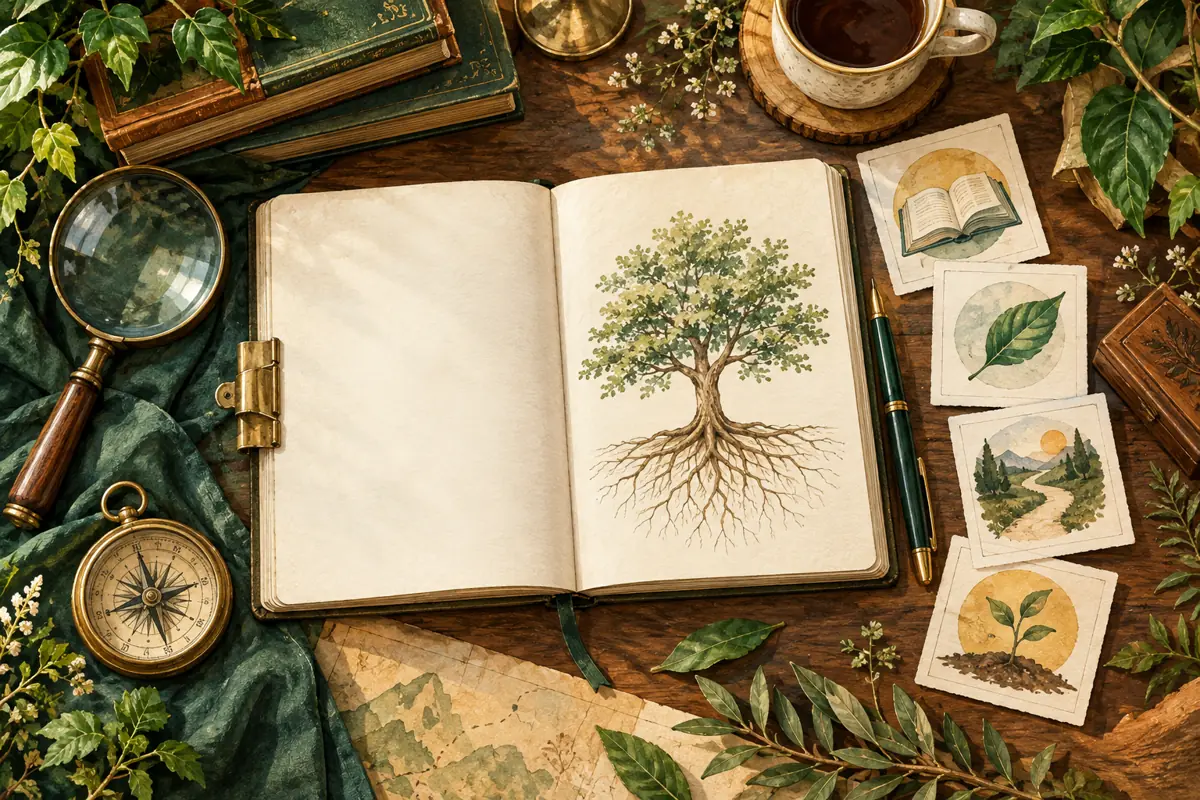
Explore the Sahabi Tree through short, readable guides: where the story is remembered, how to examine a claim, and how to turn reflection into respectful care.
These infographic panels use editable text rather than flattened screenshots. They work on mobile, can be printed, and keep source notes close to the ideas they explain.
Four guides to begin with
Place / Story / Evidence
Place: near Safawi, Jordan.
Story: traditionally associated with shelter on a journey of the Prophet Muhammad ﷺ.
Evidence: modern heritage descriptions document the tradition; they are not proof of the tree’s identity in an early account.
Three questions to ask
1. Who says it?
Find an identifiable reference.
2. What kind of claim?
Documented event, tradition or reflection?
3. What remains uncertain?
Keep qualifications in your summary.
Tree image ≠ tree identity
A scriptural metaphor can inspire reflection without naming a particular living tree.
A religious narrative can mention a tree without establishing that a tree alive today is the same one.
An illustration can explain without being a historical record.
Learn / Protect / Share
Learn: read the context before repeating a claim.
Protect: do not damage trees or take pieces as souvenirs.
Share: keep sources attached and label artwork honestly.
These are practical editorial suggestions for respectful learning.
A short timeline
Early journey tradition
The tree’s story looks back to a journey towards Syria. We do not assign an exact year to the tree identification.
2019 · A visitor centre
The Royal Hashemite Court records a visitor centre opening on 9 October.
Today · Continued learning
Our task as readers is to preserve the distinction between a source, a tradition and our own response.
Share knowledge responsibly
When sharing a guide, keep its source note and its distinction between history, tradition and reflection. A beautiful graphic should make uncertainty clearer, not hide it.
From roots to words
What supports the claim?
Look for a clear reference, read its context and keep qualifications such as “estimated” or “traditionally associated”.
How will the words travel?
Use a caption that helps the next reader understand the source. Keep uncertainty visible when summarising.
This is an editorial learning metaphor. Qur’an 14:24 uses the image of a good tree; it does not identify the Sahabi Tree. Read the verse.
A practical reading checklist
- Name the source. A book, verse, narration or dated record is more useful than “people say”.
- Identify the claim. Is it a documented event, a tradition or a reflection?
- Check the context. Read around the excerpt before repeating it.
- Keep limits visible. A photograph shows an appearance; it does not prove an ancient event.
- Share responsibly. Keep source links attached and label original or generated artwork.
Using these guides
Read the panels together with the history and source-policy pages. When sharing them, retain their references and qualifications. A simple guide should make a subject easier to understand without pretending every question has been settled.
The page illustration is original artwork. It is not a historical artefact or evidence of the site’s appearance.
Take the Sahabi Tree guide with you.
Basic details, historical context, how to reach the tree, regional stops and clickable source and map links.
Edition: 15 October 2026. Check current access and travel advice before travelling.